

Episode 1
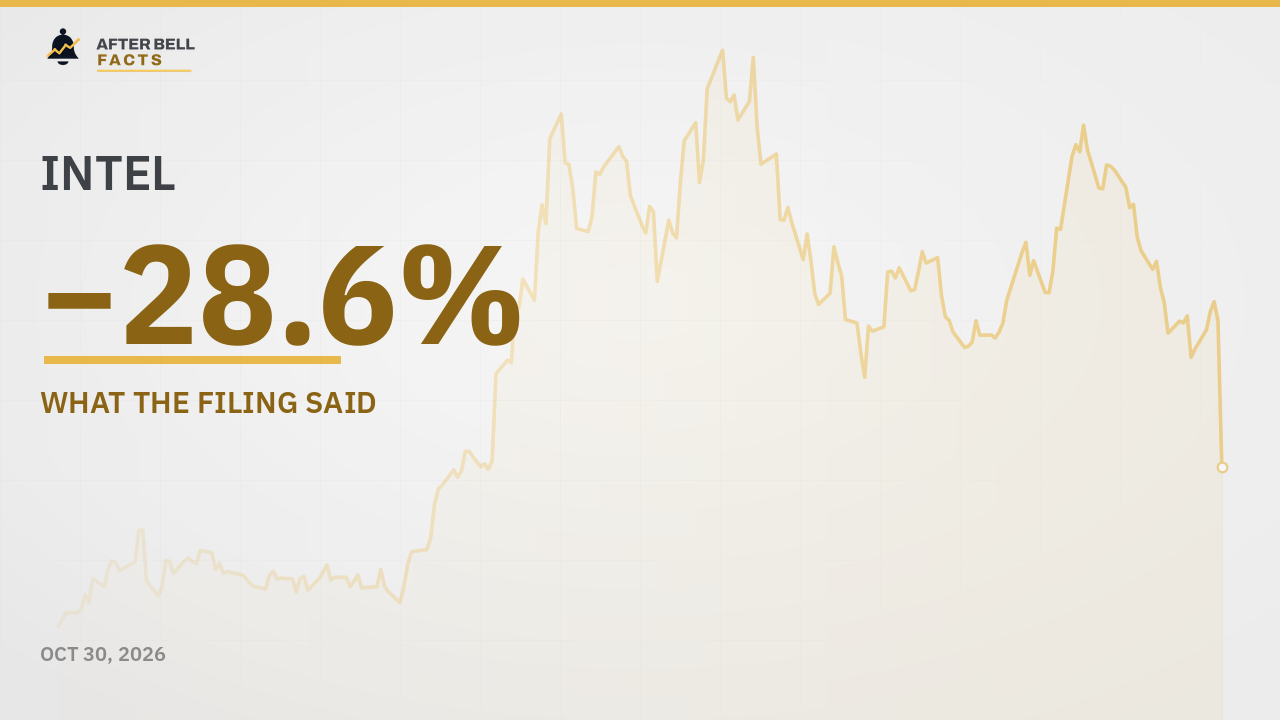
Intel Fell 28.6% on October 30. Here's What the Filing Said.
Prices as of the October 30, 2026 regular-session close (Nasdaq). Company figures from Intel's October 29, 2026 8-K/Exhibit 99.1 and Form 10-Q for the quarter ended September 26, 2026. Analyst estimates as reported by CNBC (LSEG) on October 29–30, 2026. Links checked November 24, 2026.
Video published November 23, 2026. Page and podcast published November 24, 2026.
For informational and educational purposes only. Not financial, investment, tax, or legal advice, and not a recommendation to buy, sell, or hold any security.
Podcast
Listen on Apple Podcasts Listen on Spotify Listen on Amazon Music Listen on RSS.com
This episode is narrated with an AI voice.
Key findings
- Intel closed at $65.76 on October 30, 2026, down 28.6% (28.58% to two decimals, or $26.31) from the October 29 close of $92.07. The regular Nasdaq session opened at $68.36 and traded as low as $63.20. Volume was about 456 million shares, more than three times Thursday's volume of about 134 million shares, by our arithmetic.
- The company had furnished an 8-K the afternoon of October 29 (accepted 4:08 p.m. Eastern; accession 0000050863-26-000188) with Exhibit 99.1, “Intel Reports Third-Quarter 2026 Financial Results,” for the quarter ended September 26, 2026. Intel said the quarter exceeded its guidance.
- Third-quarter revenue was $16.5 billion ($16,513 million in the detailed table), up 21% from $13.7 billion a year earlier. GAAP earnings per share attributable to Intel were $0.60; non-GAAP earnings per share were $0.52. GAAP net income attributable to Intel was $3.3 billion, down 18% from $4.1 billion.
- In the same release, Intel forecast fourth-quarter revenue of $15.0 billion to $16.0 billion (midpoint $15.5 billion), GAAP earnings per share of $0.10, and non-GAAP earnings per share of $0.25. CNBC, citing LSEG, said analysts had been expecting $17.1 billion and $0.43 a share. By our arithmetic, that midpoint is $1.6 billion below the LSEG revenue estimate. On the call, Ben Reitzes of Melius described the guide as about $1.8 billion below “the street.” He did not say which estimate he meant, so the two gaps are not reconciled here. Those consensus figures are not in Intel's filing.
- The business was not one story. Data Center and AI revenue was $7.3 billion, up 78%. Client Computing and Physical AI Group revenue was $8.1 billion, down 5%. In the release, CFO David Zinsner said the company sees the PC slowdown continuing at least through the first half of next year, meaning 2027.
- CEO Lip-Bu Tan pointed to a factory accident in Israel. Zinsner's early assessment put the fourth-quarter impact at roughly $300 million of revenue and 200 basis points of gross margin, almost all of it tied to 10-nanometer server products. News organizations, including CNBC, reported that the accident killed two workers and seriously injured a third. Intel's 10-Q confirms employee casualties and injuries but gives no count; the casualty figures come from those news reports.
- By our calculation, using the 5.31 billion shares outstanding reported as of September 26, Friday's close-to-close move works out to a decline of about $140 billion in market value. That share count is a quarter-end figure, not a same-day exchange print. As a cross-check, the 10-Q cover gives 5.315 billion shares as of October 23, 2026, which works out to about $139.8 billion, still about $140 billion. Yahoo Finance independently put the move at nearly $140 billion.
Report
0:00 The October 30 close
On Friday, October 30, 2026, Intel stock closed at $65.76. That was down 28.6% from the previous close of $92.07. The official close-to-close change is $26.31, or 28.58%, stated here and in the video as 28.6%. The company had published its third-quarter results the afternoon before. The quarter, by the company's own account, exceeded its guidance. Here is what the filing, the call, and the official close actually show.
0:26 The October 29 filing and earnings call
Start with the calendar, in Eastern Time.
Thursday, October 29. After the U.S. market close, Intel furnished an 8-K with the Securities and Exchange Commission. The filing time on EDGAR is 4:08 p.m. Eastern (accepted 16:08:53 Eastern). Attached as Exhibit 99.1 is the press release dated October 29, 2026: “Intel Reports Third-Quarter 2026 Financial Results.” The quarter ended September 26, 2026.
The same afternoon, at 2:00 p.m. Pacific — that is 5:00 p.m. Eastern — Intel held its public earnings webcast, led by chief executive Lip-Bu Tan and chief financial officer David Zinsner.
News reports said the stock fell in after-hours trading that evening. This episode does not use a single after-hours percentage, because published accounts of that move did not agree.
1:20 The October 30 session
Friday, October 30. The regular Nasdaq session opened at $68.36. The session low was $63.20. Intel closed at $65.76, down $26.31, or 28.6%, from Thursday's close. Volume was about 456 million shares, more than three times Thursday's volume of about 134 million shares, by our arithmetic.
1:47 How the decline entered the news
That one-day decline is how this event entered the news. Yahoo Finance later wrote, in “Intel stock plunges nearly 29%, its worst day since 1974” (Jared Blikre, November 2, 2026), that based on Norgate Data closing prices going back to May 1973, only one session was worse: July 5, 1974. CNBC, reporting on October 30, called it the stock's worst day since the 1970s. Those history claims are other outlets' figures, citing Norgate Data in Yahoo's case; this channel did not independently audit that history. This page uses 28.6% for the official close-to-close move, not the 29% rounding that appears in some headlines.
2:14 Third-quarter results
Now the quarter, from the press release attached to the 8-K.
Revenue was $16.5 billion. The detailed segment table in the same release shows $16,513 million. That was up 21% from $13.7 billion a year earlier.
GAAP earnings per share attributable to Intel were $0.60. Non-GAAP earnings per share were $0.52. On a GAAP basis, earnings per share were down 33% from $0.90 a year earlier. On a non-GAAP basis, they were up 126% from $0.23. GAAP net income attributable to Intel was $3.3 billion, down 18% from $4.1 billion.
GAAP gross margin was 43.0%. Non-GAAP gross margin was 44.1%. Cash from operations in the quarter was $5.1 billion. Cash and short-term investments at quarter-end were about $54 billion.
3:16 Segments and the equity offering
The business was not one story. Client Computing and Physical AI Group revenue was $8.1 billion, down 5% year over year. Data Center and AI revenue was $7.3 billion, up 78%. In the release, Zinsner called that the company's strongest data center revenue growth in 15 years. Intel Foundry revenue was $6.7 billion, up 58%. Those segment figures include intersegment sales.
The company also said it had completed a $23 billion public equity offering. As of September 26, shares issued and outstanding were 5.31 billion, up from 4.99 billion as of December 27, 2025 (fiscal year-end).
4:01 Published estimates (not in the filing)
CNBC, citing LSEG, said analysts had expected third-quarter adjusted earnings of $0.40 a share and revenue of $16.5 billion. Those are other firms' estimates, as reported by CNBC, and are not in Intel's filing. Non-GAAP earnings were ahead of that published estimate. Revenue was roughly in line.
4:19 The fourth-quarter outlook
If the quarter beat the company's guidance, why did the stock fall in the next regular session? News coverage, including CNBC and Yahoo Finance, tied the decline to the fourth-quarter outlook. The public record on that outlook includes what executives said about the PC market and a factory shutdown.
In the same release, Intel forecast fourth-quarter revenue of $15 billion to $16 billion. It forecast GAAP earnings per share of $0.10, and non-GAAP earnings per share of $0.25. Fourth-quarter GAAP gross margin was guided to 37.1%, and non-GAAP gross margin to 38.0%, both based on the midpoint of the revenue range.
CNBC, citing LSEG, said analysts had been expecting fourth-quarter revenue of $17.1 billion and earnings per share of $0.43. On the earnings call, an analyst from Melius, Ben Reitzes, described the guide as about $1.8 billion below “the street.” The midpoint of Intel's range is $15.5 billion. By our arithmetic, that midpoint is $1.6 billion below the LSEG revenue estimate. Reitzes did not say which estimate he meant by “the street,” so the two gaps are not reconciled here. This channel is not adopting anyone's target.
5:32 The PC slowdown, the factory shutdown, and supply
Zinsner, in the release, said:
“Looking ahead, we see the PC slowdown continuing at least through the first half of next year.”
That is the first half of 2027.
On the call, according to an unofficial transcript published by StockAnalysis, he said the company expects Client Computing revenue to “decline greater than 20 percent sequentially as customers move quickly to reduce weeks of inventory.”
Tan, on the same call, pointed to a second issue:
“Early this month, an unfortunate and tragic accident led to an extended shutdown in our Israel factory.”
He said it would affect fourth-quarter 10-nanometer server shipments.
Zinsner put a number on that, and called it an early assessment. He said guidance included an impact of roughly $300 million to revenue, and 200 basis points to gross margin, from the incident at Fab 28, almost all of it tied to 10-nanometer server products. He said the plant had been shut down for about two weeks, that production was expected to restart by the end of that week, and that a similar revenue impact was likely in the first quarter, with most wafer write-offs expected in the fourth quarter.
News organizations, including CNBC, reported that the accident killed two workers and seriously injured a third. Intel's 10-Q confirms employee casualties and injuries but gives no count; the casualty figures come from those news reports.
Tan also described other limits on server supply: yields on the Intel 3 process, and an industry-wide shortage of advanced organic substrates used in EMIB packaging. In the unofficial transcript, Zinsner said demand for data-center and AI products continued to exceed available supply.
6:59 Analyst ratings on October 30
On Friday, CNBC reported that D.A. Davidson had downgraded the stock to neutral from buy, in a report titled “Not fixed yet.” The analysts wrote, as quoted by CNBC: “We understand the PC market is being impacted at the industry level. However it is hard to justify the current multiple when weakness is so significant.” That is D.A. Davidson's published view, as reported by CNBC, not this channel's.
7:23 The 2026 price path
The stock did not arrive at Thursday's close from a standing start. It had already moved a long way in 2026. Intel closed 2025 at $36.90. By October 29, it had closed at $92.07 — up about 150% from that year-end close, by our arithmetic. CNBC reported the same rough figure. It had also already fallen during October. The stock closed October 1 at $120.00, then closed October 29 more than 23% lower, by our arithmetic, before Friday's session. CNBC described the October decline as roughly 23%.
7:54 What the figures show — and what they do not
Here is what those figures show, and what they do not.
They show a regular-session decline of 28.6% on October 30, on heavy volume, after a quarter that the company said exceeded its guidance, and after a fourth-quarter outlook that was below published analyst estimates.
They show a split inside the company: data-center revenue up sharply, client computing down, and management saying it sees the PC slowdown continuing at least through the first half of next year, meaning 2027.
They show the company itself tying part of the fourth-quarter guide — about $300 million of revenue, by the CFO's early estimate — to a factory accident in Israel, and saying a similar revenue effect could appear in the first quarter.
They do not show what the stock will do next. A one-day move is not a forecast.
They do not tell you whether Intel is cheap or expensive. A multiple or a downgrade is an analyst's opinion, not a fact in the filing.
Guidance is the company's forecast, not a guarantee, and not this channel's forecast. Intel's own release warns that actual results may differ materially.
9:02 Approximate market-value change
By our calculation, using the 5.31 billion shares outstanding reported as of September 26, Friday's close-to-close move works out to a decline of about $140 billion in market value. That share count is a quarter-end figure, not a same-day exchange print. Treat the dollar amount as an approximation. As a cross-check, the 10-Q cover gives 5.315 billion shares as of October 23, 2026, which works out to about $139.8 billion, still about $140 billion. Yahoo Finance independently put the move at nearly $140 billion.
9:24 Sources and disclosure
On October 30, 2026, Intel shares closed at $65.76, down 28.6%. The primary documents are the October 29 8-K and the earnings release attached as Exhibit 99.1. Links are in the source list below.
This channel reviews publicly reported U.S. market events and documents. It is for information only. It is not investment, tax, or legal advice, and it is not a recommendation to buy, sell, or hold any security. Figures come from the sources listed below, and those sources may revise them later.
Video transcript
Transcript of the published long-form narration, set from the source paragraphs rather than the SRT. Some wording differs from the report above; see Corrections. The on-screen outro (“After Bell Facts is for informational and educational purposes only…”) is not repeated here.
On Friday, October 30, 2026, Intel stock closed at sixty-five dollars and seventy-six cents. That was down twenty-eight point six percent from the previous close of ninety-two dollars and seven cents. The company had published its third-quarter results the afternoon before. The quarter, by the company’s own account, exceeded its guidance. Here is what the filing, the call, and the official close actually show.
Start with the calendar, in Eastern Time.
Thursday, October 29. After the U.S. market close, Intel furnished an 8-K with the Securities and Exchange Commission. The filing time on EDGAR is 4:08 p.m. Eastern. Attached as Exhibit 99.1 is the press release dated October 29, 2026: “Intel Reports Third-Quarter 2026 Financial Results.” The quarter ended September 26, 2026.
The same afternoon, at 2:00 p.m. Pacific — that is 5:00 p.m. Eastern — Intel held its public earnings webcast, led by chief executive Lip-Bu Tan and chief financial officer David Zinsner.
News reports said the stock fell in after-hours trading that evening. This script does not use a single after-hours percentage, because published accounts of that move did not agree.
Friday, October 30. The regular Nasdaq session opened at sixty-eight dollars and thirty-six cents. The session low was sixty-three dollars and twenty cents. Intel closed at sixty-five dollars and seventy-six cents, down twenty-six dollars and thirty-one cents, or twenty-eight point six percent, from Thursday’s close. Volume was about four hundred fifty-six million shares, more than three times Thursday’s volume of about one hundred thirty-four million shares.
That one-day decline is how this event entered the news. Yahoo Finance later wrote that, based on Norgate Data closing prices going back to May 1973, only one session was worse: July 5, 1974. CNBC, reporting on October 30, called it the stock’s worst day since the 1970s. This channel did not independently audit that history.
Now the quarter, from the press release attached to the 8-K.
Revenue was sixteen point five billion dollars. The detailed segment table in the same release shows sixteen billion, five hundred thirteen million dollars. That was up 21 percent from thirteen point seven billion dollars a year earlier.
GAAP earnings per share attributable to Intel were sixty cents. Non-GAAP earnings per share were fifty-two cents. On a GAAP basis, earnings per share were down 33 percent from ninety cents a year earlier. On a non-GAAP basis, they were up 126 percent from twenty-three cents. GAAP net income attributable to Intel was three point three billion dollars, down 18 percent from four point one billion.
GAAP gross margin was 43.0 percent. Non-GAAP gross margin was 44.1 percent. Cash from operations in the quarter was five point one billion dollars. Cash and short-term investments at quarter-end were about fifty-four billion dollars.
The business was not one story. Client Computing and Physical AI Group revenue was eight point one billion dollars, down 5 percent year over year. Data Center and AI revenue was seven point three billion dollars, up 78 percent. In the release, Zinsner called that the company’s strongest data center revenue growth in fifteen years. Intel Foundry revenue was six point seven billion dollars, up 58 percent. Those segment figures include intersegment sales.
The company also said it had completed a twenty-three billion dollar public equity offering. As of September 26, shares issued and outstanding were five point three one billion, up from four point nine nine billion at the end of 2025.
CNBC, citing LSEG, said analysts had expected third-quarter adjusted earnings of forty cents a share and revenue of sixteen point five billion dollars. Non-GAAP earnings were ahead of that published estimate. Revenue was roughly in line. Those consensus figures are not in Intel’s filing.
If the quarter beat the company’s guidance, why did the stock fall in the next regular session? The public record points to the fourth-quarter outlook, and to what executives said about the PC market and a factory shutdown.
In the same release, Intel forecast fourth-quarter revenue of fifteen billion to sixteen billion dollars. It forecast GAAP earnings per share of ten cents, and non-GAAP earnings per share of twenty-five cents. Fourth-quarter GAAP gross margin was guided to 37.1 percent, and non-GAAP gross margin to 38.0 percent, both based on the midpoint of the revenue range.
CNBC, citing LSEG, said analysts had been expecting fourth-quarter revenue of seventeen point one billion dollars and earnings per share of forty-three cents. On the earnings call, an analyst from Melius, Ben Reitzes, described the guide as about one point eight billion dollars below “the street.” The midpoint of Intel’s range is fifteen point five billion dollars. This channel is not adopting anyone’s target.
Zinsner, in the release, said, quote: “Looking ahead, we see the PC slowdown continuing at least through the first half of next year.” On the call, according to a transcript published by StockAnalysis, he said the company expects Client Computing revenue to “decline greater than 20 percent sequentially as customers move quickly to reduce weeks of inventory.”
Tan, on the same call, pointed to a second issue. Quote: “Early this month, an unfortunate and tragic accident led to an extended shutdown in our Israel factory.” He said it would affect fourth-quarter ten-nanometer server shipments.
Zinsner put a number on that, and called it an early assessment. He said guidance included an impact of roughly three hundred million dollars to revenue, and two hundred basis points to gross margin, from the incident at Fab 28, almost all of it tied to ten-nanometer server products. He said the plant had been shut down for about two weeks, that production was expected to restart by the end of that week, and that a similar revenue impact was likely in the first quarter, with most wafer write-offs expected in the fourth quarter. News organizations, including CNBC, reported that the accident killed two workers and seriously injured a third. That casualty figure is not in the 8-K.
Tan also described other limits on server supply: yields on the Intel 3 process, and an industry-wide shortage of advanced organic substrates used in EMIB packaging. In the unofficial transcript, Zinsner said demand for data-center and AI products continued to exceed available supply.
After Friday’s close, some analysts changed their ratings. CNBC reported that D.A. Davidson downgraded the stock to neutral from buy, in a report titled “Not fixed yet.” The analysts wrote, as quoted by CNBC: “We understand the PC market is being impacted at the industry level. However it is hard to justify the current multiple when weakness is so significant.” That is their published view, not this channel’s. [Corrected below: CNBC reported the downgrade on Friday; the time was not reported. Corrections]
The stock did not arrive at Thursday’s close from a standing start. It had already moved a long way in 2026. Intel closed 2025 at thirty-six dollars and ninety cents. By October 29, it had closed at ninety-two dollars and seven cents — up about 150 percent from that year-end close. It had also already fallen during October. The stock closed October 1 at one hundred twenty dollars even, then closed October 29 more than 23 percent lower, before Friday’s session.
Here is what those figures show, and what they do not.
They show a regular-session decline of 28.6 percent on October 30, on heavy volume, after a quarter that the company said exceeded its guidance, and after a fourth-quarter outlook that was below published analyst estimates.
They show a split inside the company: data-center revenue up sharply, client computing down, and management saying the PC slowdown would last at least through the first half of 2027.
They show the company itself tying part of the fourth-quarter guide — about three hundred million dollars of revenue, by the CFO’s early estimate — to a factory accident in Israel, and saying a similar revenue effect could appear in the first quarter.
They do not show what the stock will do next. A one-day move is not a forecast.
They do not tell you whether Intel is cheap or expensive. A multiple or a downgrade is an analyst’s opinion, not a fact in the filing.
Guidance is the company’s forecast, not a guarantee, and not this channel’s forecast. Intel’s own release warns that actual results may differ materially.
Using the five point three one billion shares outstanding reported as of September 26, Friday’s close-to-close move implies a decline of about one hundred forty billion dollars in market value. That share count is a quarter-end figure, not a same-day exchange print. Treat the dollar amount as an approximation.
On October 30, 2026, Intel shares closed at sixty-five dollars and seventy-six cents, down 28.6 percent. The primary documents are the October 29 8-K and the earnings release attached as Exhibit 99.1. Links are in the description.
This channel reviews publicly reported U.S. market events and documents. It is for information only. It is not investment, tax, or legal advice, and it is not a recommendation to buy, sell, or hold any security. Figures come from the sources on screen and in the description, and those sources may revise them later.
Podcast transcript
Transcript of the episode podcast, from the final spoken script. The spoken AI-voice disclosure at the start and the closing disclaimer are not repeated here.
On Friday, October 30, 2026, Intel stock closed at sixty-five dollars and seventy-six cents. That was down twenty-eight point six percent from the previous close of ninety-two dollars and seven cents. The company had published its third-quarter results the afternoon before. The quarter, by the company’s own account, exceeded its guidance. Here is what the filing, the call, and the official close actually show.
Start with the calendar, in Eastern Time.
Thursday, October 29. After the U.S. market close, Intel furnished an 8-K with the Securities and Exchange Commission. The filing time on EDGAR is four oh eight p.m. Eastern. Attached as Exhibit 99.1 is the press release dated October 29, 2026: “Intel Reports Third-Quarter 2026 Financial Results.” The quarter ended September 26, 2026.
The same afternoon, at two p.m. Pacific — that is five p.m. Eastern — Intel held its public earnings webcast, led by chief executive Lip-Bu Tan and chief financial officer David Zinsner.
News reports said the stock fell in after-hours trading that evening. This episode does not use a single after-hours percentage, because published accounts of that move did not agree.
Friday, October 30. The regular Nasdaq session opened at sixty-eight dollars and thirty-six cents. The session low was sixty-three dollars and twenty cents. Intel closed at sixty-five dollars and seventy-six cents, down twenty-six dollars and thirty-one cents, or twenty-eight point six percent, from Thursday’s close. Volume was about four hundred fifty-six million shares, more than three times Thursday’s volume of about one hundred thirty-four million shares, by our arithmetic.
That one-day decline is how this event entered the news. Yahoo Finance later wrote that, based on Norgate Data closing prices going back to May 1973, only one session was worse: July 5, 1974. CNBC, reporting on October 30, called it the stock’s worst day since the 1970s. This channel did not independently audit that history.
Now the quarter, from the press release attached to the 8-K.
Revenue was sixteen point five billion dollars. The detailed segment table in the same release shows sixteen billion, five hundred thirteen million dollars. That was up 21 percent from thirteen point seven billion dollars a year earlier.
GAAP earnings per share attributable to Intel were sixty cents. Non-GAAP earnings per share were fifty-two cents. On a GAAP basis, earnings per share were down 33 percent from ninety cents a year earlier. On a non-GAAP basis, they were up 126 percent from twenty-three cents. GAAP net income attributable to Intel was three point three billion dollars, down 18 percent from four point one billion.
GAAP gross margin was forty-three point zero percent. Non-GAAP gross margin was 44.1 percent. Cash from operations in the quarter was five point one billion dollars. Cash and short-term investments at quarter-end were about fifty-four billion dollars.
The business was not one story. Client Computing and Physical AI Group revenue was eight point one billion dollars, down 5 percent year over year. Data Center and AI revenue was seven point three billion dollars, up 78 percent. In the release, Zinsner called that the company’s strongest data center revenue growth in fifteen years. Intel Foundry revenue was six point seven billion dollars, up 58 percent. Those segment figures include intersegment sales.
The company also said it had completed a twenty-three billion dollar public equity offering. As of September 26, shares issued and outstanding were five point three one billion, up from four point nine nine billion at the end of 2025.
CNBC, citing LSEG, said analysts had expected third-quarter adjusted earnings of forty cents a share and revenue of sixteen point five billion dollars. Non-GAAP earnings were ahead of that published estimate. Revenue was roughly in line. Those consensus figures are not in Intel’s filing.
If the quarter beat the company’s guidance, why did the stock fall in the next regular session? News coverage, including CNBC and Yahoo Finance, tied the decline to the fourth-quarter outlook. The public record on that outlook includes what executives said about the PC market and a factory shutdown.
In the same release, Intel forecast fourth-quarter revenue of fifteen billion to sixteen billion dollars. It forecast GAAP earnings per share of ten cents, and non-GAAP earnings per share of twenty-five cents. Fourth-quarter GAAP gross margin was guided to 37.1 percent, and non-GAAP gross margin to thirty-eight point zero percent, both based on the midpoint of the revenue range.
CNBC, citing LSEG, said analysts had been expecting fourth-quarter revenue of seventeen point one billion dollars and earnings per share of forty-three cents. On the earnings call, an analyst from Melius, Ben Reitzes, described the guide as about one point eight billion dollars below “the street.” The midpoint of Intel’s range is fifteen point five billion dollars. By our arithmetic, that midpoint is one point six billion dollars below the LSEG revenue estimate. Reitzes did not say which estimate he meant by “the street,” so the two gaps are not reconciled here. This channel is not adopting anyone’s target.
Zinsner, in the release, said, quote: “Looking ahead, we see the PC slowdown continuing at least through the first half of next year.” On the call, according to a transcript published by StockAnalysis, he said the company expects Client Computing revenue to “decline greater than 20 percent sequentially as customers move quickly to reduce weeks of inventory.”
Tan, on the same call, pointed to a second issue. Quote: “Early this month, an unfortunate and tragic accident led to an extended shutdown in our Israel factory.” He said it would affect fourth-quarter ten-nanometer server shipments.
Zinsner put a number on that, and called it an early assessment. He said guidance included an impact of roughly three hundred million dollars to revenue, and two hundred basis points to gross margin, from the incident at Fab 28, almost all of it tied to ten-nanometer server products. He said the plant had been shut down for about two weeks, that production was expected to restart by the end of that week, and that a similar revenue impact was likely in the first quarter, with most wafer write-offs expected in the fourth quarter. News organizations, including CNBC, reported that the accident killed two workers and seriously injured a third. That casualty figure is not in the 8-K.
Tan also described other limits on server supply: yields on the Intel 3 process, and an industry-wide shortage of advanced organic substrates used in EMIB packaging. In the unofficial transcript, Zinsner said demand for data-center and AI products continued to exceed available supply.
On Friday, CNBC reported that D.A. Davidson had downgraded the stock to neutral from buy, in a report titled “Not fixed yet.” The analysts wrote, as quoted by CNBC: “We understand the PC market is being impacted at the industry level. However it is hard to justify the current multiple when weakness is so significant.” That is their published view, not this channel’s.
The stock did not arrive at Thursday’s close from a standing start. It had already moved a long way in 2026. Intel closed 2025 at thirty-six dollars and ninety cents. By October 29, it had closed at ninety-two dollars and seven cents — up about 150 percent from that year-end close, by our arithmetic. CNBC reported the same rough figure. It had also already fallen during October. The stock closed October 1 at one hundred twenty dollars even, then closed October 29 more than 23 percent lower, by our arithmetic, before Friday’s session.
Here is what those figures show, and what they do not.
They show a regular-session decline of 28.6 percent on October 30, on heavy volume, after a quarter that the company said exceeded its guidance, and after a fourth-quarter outlook that was below published analyst estimates.
They show a split inside the company: data-center revenue up sharply, client computing down, and management saying it sees the PC slowdown continuing at least through the first half of next year, meaning 2027.
They show the company itself tying part of the fourth-quarter guide — about three hundred million dollars of revenue, by the CFO’s early estimate — to a factory accident in Israel, and saying a similar revenue effect could appear in the first quarter.
They do not show what the stock will do next. A one-day move is not a forecast.
They do not tell you whether Intel is cheap or expensive. A multiple or a downgrade is an analyst’s opinion, not a fact in the filing.
Guidance is the company’s forecast, not a guarantee, and not this channel’s forecast. Intel’s own release warns that actual results may differ materially.
By our calculation, using the five point three one billion shares outstanding reported as of September 26, Friday’s close-to-close move works out to a decline of about one hundred forty billion dollars in market value. That share count is a quarter-end figure, not a same-day exchange print. Treat the dollar amount as an approximation.
On October 30, 2026, Intel shares closed at sixty-five dollars and seventy-six cents, down 28.6 percent. The primary documents are the October 29 8-K and the earnings release attached as Exhibit 99.1. Links are in the show notes.
This channel reviews publicly reported U.S. market events and documents. It is for information only. It is not investment, tax, or legal advice, and it is not a recommendation to buy, sell, or hold any security. Figures come from the sources in the show notes, and those sources may revise them later.
Sources
- Intel Form 8-K, filed October 29, 2026 (SEC accession 0000050863-26-000188), accepted 16:08:53 Eastern: https://www.sec.gov/Archives/edgar/data/50863/0000050863-26-000188-index.htm
- Exhibit 99.1, “Intel Reports Third-Quarter 2026 Financial Results,” dated October 29, 2026, quarter ended September 26, 2026: https://www.sec.gov/Archives/edgar/data/50863/000005086326000188/q326earningsrelease.htm
- 8-K HTML: https://www.sec.gov/Archives/edgar/data/50863/000005086326000188/intc-20261029.htm
- Intel Form 10-Q for the quarter ended September 26, 2026 (SEC accession 0000050863-26-000191): https://www.sec.gov/Archives/edgar/data/50863/0000050863-26-000191-index.htm
- Intel Newsroom pointer: https://www.intel.com/content/www/us/en/newsroom/news/corporate/intel-third-quarter-2026-financial-results.html
- Price and volume (including the October 29 close of $92.07 and the October 30 close of $65.76, down 28.58%, shown in this episode as 28.6%): StockAnalysis historical data from S&P Global Market Intelligence, last checked November 23, 2026: https://stockanalysis.com/stocks/intc/history/. Yahoo Finance historical prices show the same official close of $65.76: https://finance.yahoo.com/quote/INTC/history/. The price-path series uses Yahoo Finance daily historical prices for INTC, retrieved November 23, 2026, and is plotted only through October 30, 2026. Year-end 2025 close: Yahoo Finance, December 31, 2025 close $36.90.
- Unofficial transcript of Intel's October 29, 2026 earnings call, published by StockAnalysis: https://stockanalysis.com/stocks/intc/transcripts/714242-q3-2026/. The PC-slowdown sentence quoted above is from Exhibit 99.1, not from that transcript. Call remarks attributed to Lip-Bu Tan, David Zinsner, and Ben Reitzes are from this unofficial transcript.
- CNBC, “Intel stock plunges 21% as chipmaker blames PC slowdown for weak guidance,” published October 29, 2026, updated 8:39 p.m. ET (Q3 results vs. LSEG estimates; those consensus figures are not in Intel's filing): https://www.cnbc.com/2026/10/29/intel-intc-q3-earnings-report-2026-.html
- CNBC, “Intel stock has worst day since 1970s, wiping about $12 billion off government's stake” (originally headlined “Amazon, Intel shares fall after earnings amid AI spending concerns”), published October 30, 2026, updated 4:30 p.m. ET (includes LSEG fourth-quarter consensus figures and the D.A. Davidson downgrade, which is that firm's published view, not this channel's): https://www.cnbc.com/2026/10/30/amazon-intel-earnings-big-tech-ai-spending-concerns.html
- Yahoo Finance, Jared Blikre, November 2, 2026, “Intel stock plunges nearly 29%, its worst day since 1974,” on the session as Intel's worst day since 1974, based on Norgate Data (not independently audited in this episode): https://finance.yahoo.com/markets/article/intel-stock-plunges-nearly-29-its-worst-day-since-1974-205955309.html
- After Bell Facts long-form and Short, published November 23, 2026: https://www.youtube.com/watch?v=fey0eDV30c8 and https://www.youtube.com/watch?v=r2M_zuVaAUw.
Corrections
Correction: the video says D.A. Davidson's downgrade came after Friday's close. CNBC reported it on Friday, October 30; the exact time was not reported.
Correction: an on-screen card credits John Pitzer to Exhibit 99.1 and the unofficial transcript. Pitzer is named only in the unofficial earnings-call transcript, as Corporate VP of Investor Relations, not in Exhibit 99.1.